Programme Design for HYROX

Start With the End, Not the Workout
If you spend enough time around HYROX training, you start to notice a pattern. Not in what works, but in how people approach it. Most people don’t really design a programme. They collect sessions. A hard run here, a savage circuit there, something that looks vaguely like a race on a Saturday. It all feels productive in isolation, but when you zoom out, there’s no real direction to it. Just effort. Programme design isn’t about how hard a session is. It’s about whether everything you’re doing is moving you toward the actual demand of the race.
Understanding the Demand of HYROX
When you look at HYROX properly, it’s not complicated in terms of what it asks of you. It’s a long effort, somewhere between 50 and 90 minutes, on average, sitting around that threshold intensity where things feel controlled until they don’t. You’re constantly moving between running and stations, and every station changes how the next run feels. So the job of the programme becomes clear. Build the ability to sustain that effort, improve efficiency in the movements, and get comfortable operating under that rolling fatigue. Everything else is just detail layered on top.
Structure of the Week
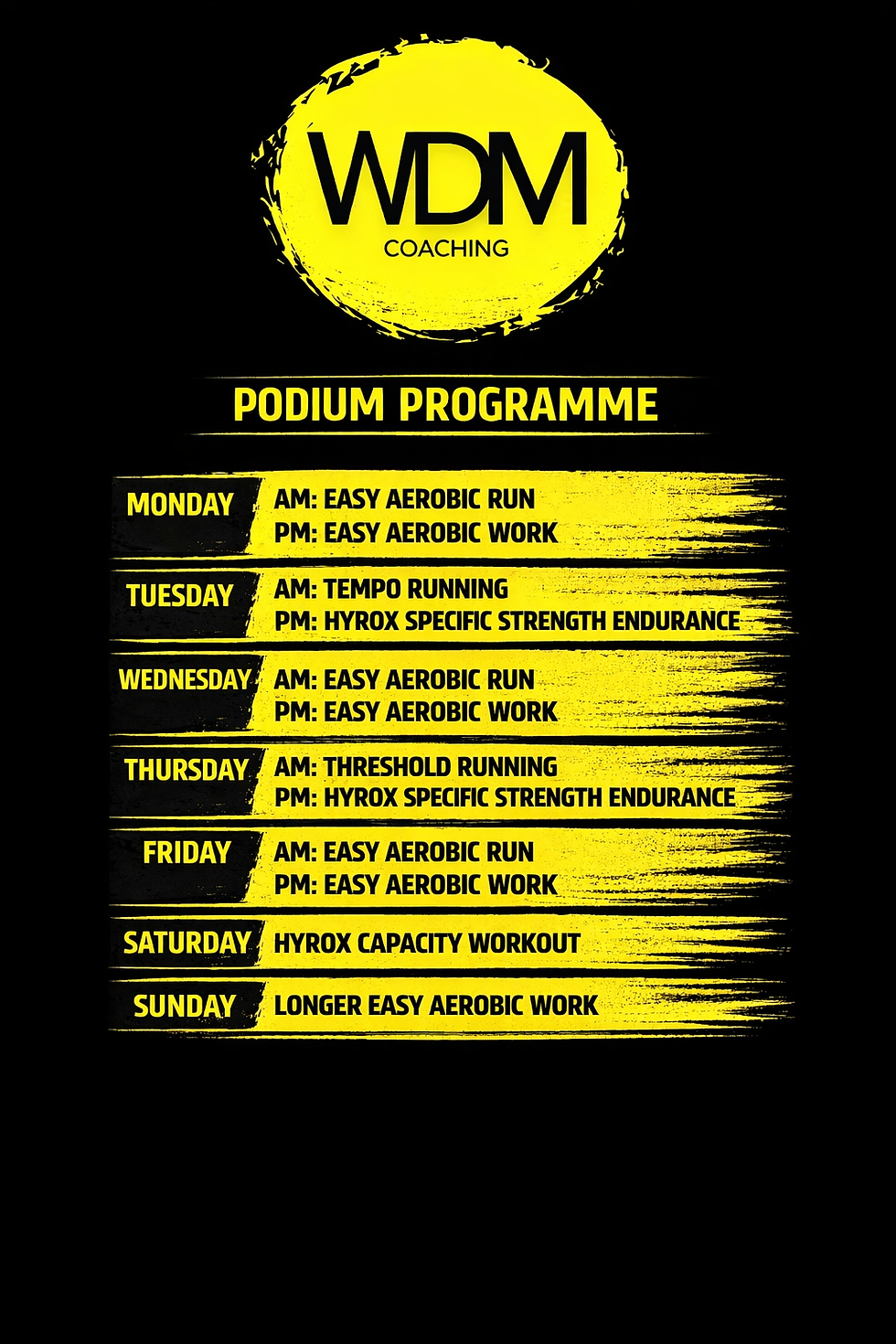
Where people tend to go wrong is trying to shortcut that process. Either they overcomplicate it with endless variation, or they just hammer intensity because it feels specific. In reality, most effective HYROX programmes look quite similar week to week because the race dictates the structure. You end up with a few key days that do the heavy lifting, usually two during the week and one at the weekend. These are your quality sessions, where you’re working around threshold, building strength endurance, or combining elements of the race. Around that, everything else supports it. That support work doesn’t always feel impressive. Easy running, aerobic work, sessions that don’t leave you ruined. But that’s exactly why it works. The job isn’t to win the session, it’s to repeat the week. Then repeat it again. And again.
Managing Intensity
Once you understand that, intensity starts to make more sense. You don’t avoid hard work, you just place it properly. You can have hard days, and sometimes even two close together depending on the structure, but you cannot stack intensity on top of intensity and expect to keep progressing. At some point, you stop adapting and just start accumulating fatigue. That often looks like working harder than ever while actually going nowhere.
Time and Volume
Then there’s the reality of time and volume. Everyone likes the idea of training more, not everyone can actually tolerate it. Your programme sits alongside your job, your sleep, your stress, everything else. So the question isn’t just what’s optimal, it’s what’s sustainable. This is where people get caught out. They jump into a level of volume that looks right on paper but is miles ahead of what they’ve been doing. It works briefly, then things start to unravel. Not because the programme was wrong, but because it wasn’t realistic. Progress here is gradual. You build capacity layer by layer until your body can actually handle the work.
Specificity Matters
There’s also a tendency to drift away from the actual movements, especially when people get bored. They start adding variations, different exercises, things that look interesting. That’s fine to a point, but eventually you stop supporting the movement and start replacing it. HYROX is very clear in what it demands. Running, lunges, sleds, ergs, wall balls. Your training needs to keep coming back to those. Not always at race intensity, that would be a terrible idea, but often enough that you improve efficiency within them. Because efficiency is what buys you time.
Progression
Progression is probably the least exciting part, but the most important. You can’t push everything forward at once. If volume goes up, intensity needs to hold. If intensity increases, something else needs to stay steady. There has to be structure to how load builds over time. Otherwise, you’re just adding stress and hoping for the best. Most good programmes work in blocks. Build something for a few weeks, reset slightly, then build again. It’s not dramatic, but it’s what allows consistent progress without burning out.
The Bigger Picture
If you zoom out far enough, programme design isn’t about any single session. It’s about whether the whole thing holds together. Does each day make sense in the context of the week? Does the week make sense in the context of the month? Can you repeat it without falling apart? If the answer is yes, you’re probably on the right track. If not, it doesn’t matter how good any individual session looks.
Final Thought
Most people are looking for something more complicated than this. Something more advanced, something that feels like the missing piece. In reality, it’s usually the opposite. Doing the basics properly, placing intensity where it belongs, building volume patiently, and sticking with it long enough for it to actually work. Not particularly exciting. But it’s what separates people who improve from those who just feel like they’re training hard. If you’re reading this and thinking your training looks a bit random, or you’re not sure how to actually structure a week like this, that’s exactly why I built my programmes. They’re set up around this exact approach. Proper structure, the right balance of running and strength endurance, and enough flexibility to fit around real life rather than pretending you’re a full-time athlete. You can have a look at them here: https://www.wdmcoaching.com/programmes


Comments